How multifunction desk gifts can earn their place in a retail range
Charging stations can look impressive in a catalogue, but buyers still need a clear use case, sensible packaging and proof that the exact configuration works as expected.



Multifunction desk gifts have obvious appeal. They can combine several everyday jobs in one compact item, offer a useful surface for branding and feel more substantial than a conventional giveaway. Yet adding more functions does not automatically make a product easier to sell.
For gift retailers, distributors and corporate merchandise suppliers, the more useful question is whether a buyer can understand the product quickly, match it to the right recipient and explain any compatibility limits before the sale. A charging station that needs a long technical explanation may struggle even when the product itself performs well.
Start with one clear reason to buy
A multifunction product should lead with one simple outcome. For a desk charging station, that might be reducing cable clutter. For a bedside version, it might be keeping time and charging essentials together. In an employee gift programme, the main value may be giving recipients one practical item they can continue using after the event.
This primary story should guide the product name, hero image, packaging front and sales description. Secondary functions can still appear, but they should support the main message rather than compete with it.
The same principle helps retailers decide where the product belongs. A charging clock presented as a piece of consumer electronics may require a different display and staff explanation from the same product positioned as a design-led desk gift.
Define what “3-in-1” means
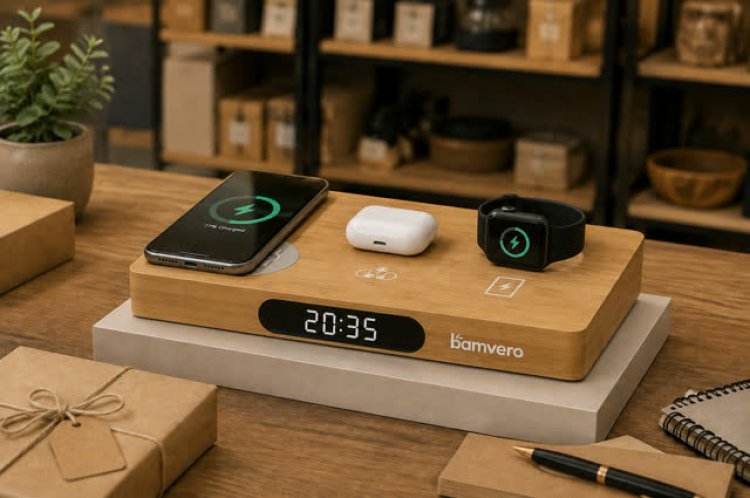
The phrase “3-in-1” is not a complete specification. One model may provide positions for a phone, wireless-earbud case and smartwatch, while another may combine charging with a clock and a separate desk function. Buyers should ask suppliers to identify each role on the exact model being quoted.
Device guidance also needs to be specific. Phone cases, watch systems, charging alignment and the selected power source can all affect the user experience. Packaging and online listings should therefore explain the intended set-up without suggesting universal compatibility.
One useful starting point is Woodshowtime’s wholesale guide to 3-in-1 bamboo charging stations, which sets out the questions buyers can use to define charging roles, supplied power accessories and sample checks before comparing quotations.
Treat packaging as part of the product
For a gift item, the retail pack has several jobs. It protects the bamboo surface, holds the supplied accessories securely, explains the charging positions and gives the customer enough information to set up the product without unnecessary support.
This means packaging should be reviewed with a powered sample rather than approved as separate artwork. Buyers can check whether the product image matches the supplied configuration, whether the included cable and power requirements are clear, and whether instructions remain readable after branding or translation changes.
Natural materials require particular care in presentation. Bamboo grain and colour will vary, so photography should show a believable finish rather than a heavily retouched surface. A material claim should also stay precise: a bamboo housing is a useful design detail, but it does not by itself describe every electronic component, accessory or packaging choice.
Make the display do some of the explaining
A customer should be able to see where the product fits into daily life. A small retail display can show a representative phone, earbuds and watch near their intended positions, while a short card explains the required power source and directs customers to compatibility information.
For online selling, the image sequence can follow the same logic. Start with the complete product, then show the charging roles, the desk footprint, the clock display, the cable route and what arrives in the box. This is more useful than repeating similar beauty shots from several angles.
Corporate-gift suppliers can apply the same approach to client presentations. Show the undecorated product first, followed by a realistic logo position and the proposed gift box. This helps prevent a large logo mock-up from becoming the only reason the item is selected.
Test the whole customer experience
Sample approval should cover more than appearance. Buyers can use a small set of representative devices and cases, record the power source used, check charging stability and note any placement instruction that should be added to the pack.
The test should also include the clock controls, display readability, bamboo finish, cable fit and packed presentation. If the product will be demonstrated in a shop or showroom, the demonstration set-up should use the same accessories and instructions planned for customers.
A limited retail or programme trial can then reveal the questions that product specifications miss. Are customers unsure where to place a device? Is the power requirement easy to understand? Does the gift box arrive in good condition? Are returns linked to compatibility, transport damage or an unclear instruction?
These answers help a buyer improve the next order instead of treating every issue as the same product fault.
Build the range around distinct jobs
Retailers do not need several products that tell the same story. A stronger range gives each item a defined role: a compact single-device charger for an accessible price point, a clock charger for bedside use, and a multi-device station for a premium desk or corporate gift.
Before placing a larger order, the buyer should be able to describe who each model is for, why its functions belong together and what evidence will trigger a reorder. That discipline turns a multifunction product from an impressive sample into a range item that staff can explain and customers can use with confidence.
Evelyn works with Woodshowtime on bamboo desk-electronics sourcing content for gift, wholesale and private-label buyers.